Showing posts with label Puffins. Show all posts

Tuesday, 29 March 2016

A Fresh Perspective!


It's been a busy few weeks on the islands as birds and rangers alike settle in for the new season. In this post, new Assistant Ranger Tom Hendry tells us what it was like coming to the islands for the first time as a Farne Islands ranger, and also what he and the team have been seeing over the past week.

The team hard at work on the new boardwalk ©Tom Hendry

"Heading out into the North Sea from Seahouses harbour, I was excited to reach Inner Farne; the tiny windswept isle that I would call home for the next six months. I’m very familiar with the Farnes, having visited many times since I was young. The prospect of working ‘out there’ on the easterly-most isle in a cluster of over 25 was nothing short of thrilling. Buffeted by fierce currents, submerged reefs and hidden rocks; I would be joining a team of Assistant Rangers for the 2016 season on behalf of the National Trust. Despite us being a mile off the Coast, we would hardly be alone, for its no secret that the islands are a paradise for birds.
This was clear on approaching the islands, as thousands of Puffins were rafting in the sea waiting for us. Having wintered in the Atlantic, puffins are true seabirds, and many of these birds still have dark smudges on their otherwise white faces. The ‘clown-make up’ metaphor is rightly used for puffins, and in late March it appears that the birds are still applying face-paint in anticipation of the new breeding season. However beautiful and flamboyant puffins appear in summer, it’s still a treat to observe them in this subdued, non-breeding plumage… a sight usually reserved for lonely winters spent on high seas, away from the prying eyes of humans.

Here one day, gone the next. Puffins on Inner Farne ©Tom Hendry

Inquisitive eyes were spying on us as we docked at the jetty, as several Grey Seal heads bobbed up and down in the bay. There is genuine curiosity and intelligence at work here and it’s a strange yet delightful feeling to be ‘watched’ by another creature for a change. The rangers had arrived.…
Seabirds Setting up Home
Thousands of seabirds had already landed on Inner Farne, with more coming in all the time. The Shags are surely entrenching themselves on the cliffs, and can be seen gathering clumps of vegetation and sticks to build their nests. These green-tinged and cool-crested birds are already pairing up, and can regularly be seen preening one another. The early birds are already on eggs and we expect to find more and more every day. The handsome and gentle faced Kittiwakes are also building nests, and can be seen courting on the cliffs. Their distinctive call and clean markings make them everyone’s favourite gull. The Fulmars are also back… these little round winged albatrosses are also engaging in courtship.

Shag sitting tight ©Tom Hendry

The aforementioned Puffins descended on Inner Farne in their hundreds, and proceeded to check out their burrows (and kick the rabbits out!) and partake in a little spring cleaning. After a couple of days, they left to resume rafting and feeding out at sea. They knew storm Katie was on the way and didn’t want to stick around. Needless to say, we all await the true return of the ‘Little brothers’ with great excitement. The chocolate-brown Guillemots and the jet black Razorbills also made a brief return to the cliffs to perform courtship, but much like the puffins, many soon departed to continue rafting and feeding in the North Sea. It’s great to see all of these beloved seabirds again, but its early days yet, and it feels like birds and rangers alike are just settling in.

Pathways and Flyways
Common but not forgotten. Fieldfare on Inner Farne ©Tom Hendry

On reaching Inner Farne in late March, I was a little shocked to see how stunted and brown the vegetation was. I usually visit in summer, when the island is much greener and as lush as an outcrop in the North Sea can be, so I was pretty surprised to see Wrens darting about. However impressive the landscape on Inner Farne is, at this time of year it is quite barren with few obvious hiding places. The wrens seem to possess an ability to appear and vanish at will… emerging from a gap in the boardwalk only to hide between dry blades of grass in the time it takes to raise your binoculars.  10+ Wrens were present on Inner Farne this past week, and they were joined by a host of other passerines which fluttered life into this not so barren isle. 
Migration is an exciting time for nature lovers. There’s nothing quite like the thrill of experiencing it on a small island, where birds seemingly drop out the sky. Surprises are everywhere. 24th March was a particularly good day, which begun when my colleague discovered a Woodcock inside the visitor information centre (I found a Goldcrest in there a couple of days after). The first Chiffchaff of the year was also present on this day, as was a very handsome male Wheatear, which lingered for a few days. Seeing the first of these familiar spring arrivals is always great, but the added presence of Fieldfare and Redwing; wintering visitors returning to Scandinavia, gave such sightings a surreal touch where seasons merge, along with flyways.

A stonking male Wheatear on Inner Farne ©Tom Hendry

Other migrants this week have included Common Snipe, Blackbirds, Song Thrush, Robin and White Wagtail. A strong Southerly wind has left several of these species sheltering in the lighthouse garden and behind walls. Raptor sightings have included Peregrine and Merlin, and sessions of seawatching have produced Common Scoter, Red-throated Diver, and impressively, two flocks of 44 and 19 Whooper Swans that flew North, the later rafting on the water. Despite all these spring arrivals (and departures), one bird family was missing last week, one which gives the Farnes so much of its charm; the terns. I’m pleased to say that on 27th March, the first Sandwich tern was spotted out at sea, flying towards Bamburgh. In the evening roost the following day there were no less than 14, surely an Easter treat everyone can appreciate!"

Wednesday, 2 December 2015

The Farne Islands Roundup


This year the National Trust celebrated 90 years of looking after the Farne Islands and as the rangers prepare to leave their island home for the winter season, here is a quick look at the highs and lows of 2015.

The major success story has been that of the Guillemots, which had another record year as numbers hit 53,461 individuals. The Farnes is a safe haven for them to breed and the surrounding sea provides a plentiful supply of sand eels for them to feed their chicks. Numbers continue to go up and up with this species, and as recently as 2002 it was half that number (25,498)! Shags also faired well. Following poor weather in 2013 the population crashed, but they have experienced two good breeding seasons since and  we should see the population start to recover nicely. This year productivity was 1.67 chicks fledged per breeding pair, compared to the 5 year mean of 1.71.


A bazaar of Guillemots                                                                © Chris Lockyer


The ringing programme continued this year with over 200 Shags being fitted with a darvik ring; a coloured ring readable in the field featuring 3 letters. If you are out and about on the North East coast this winter and spot a Shag with one of these rings please send us the data! We are trying to learn where our Shags spend their winters.

It’s not all about seabirds. Pied Wagtails and Swallows had record years, with 9 recorded Pied Wagtail nests and 11 Swallow nests. The swallows have now taken up residence in St Cuthbert’s chapel, our visitor centre, two store rooms and the Longstone Lighthouse.


Puffins                                                                                   © Ed Tooth

Sadly it wasn’t good news for all species this year. It was a notably windy season and the islands were battered by two major storms. The main damage was done when 31.5mm of rain fell over two days in early July, when most of the islands breeding species were sitting on chicks. Puffin burrows were flooded, Kittiwake nests were washed clean off the cliffs and many Tern chicks died in the rain. Puffin productivity fell from 0.91 chicks fledged per breeding pair (5 year mean) to just 0.46. Arctic Terns  also suffered. As surface feeders they rely on calm waters to be able to feed, and this coupled with the usual predation pressure they face proved too much, and productivity was just 0.21 chicks fledged per breeding pair (5 year mean 0.65).

The team on the islands battled through the weather to carry out their annual monitoring programme. This year a record number of Arctic Tern nests (1332) were monitored. Arctic Terns were also fitted with Geo-locaters, which we hope to recover from them next year to discover more about their migration routes. The seal monitoring programme is still ongoing and the rangers are hoping to reach 1800 pups by the end of December. 


Arctic Tern and chick                                   © Chris Lockyer
It was a brilliant year for cetaceans with 157 separate sightings. A basking shark and 30 sightings of White-beaked Dolphin were the undoubted highlights. The sighting of a Surf Scoter flying over the islands was another highpoint. This American sea duck is rare in British waters, and it was only the second time one has been seen on the islands.


The rangers are getting ready to shut the islands down for the winter season. The Zodiac boats are sent for their annual service on the mainland, machinery goes in for repair and the ranger team enjoy a well deserved rest before they start preparations for the 2016 season. 

Special thanks to Ed Tooth and Chris Lockyer for image permissions

Thursday, 7 May 2015

Update from the Farne Islands #2 / 2015


A Break in the Weather, Brownsman Island Credit: S Lee

Now up to our full complement of seasonal Rangers for the summer,  last Friday saw the team divide in two to be able to staff and monitor both Inner Farne and Brownsman and Staple Islands. The trip to Brownsman with a boat load of kit was a wet and bitterly cold affair, but no sooner was the lugging and heaving through hail all done, the sun came out and promised a glorious afternoon ahead. This was short-lived as further bad weather set in over the weekend, restricting visitor access to the islands over the following days. A few windows in the weather though enabled limited opening on Inner Farne giving opportunities for visitors to land and see the increasing numbers of birds, many posting some great images on social media of the Puffins, Guillemots, Shags and Razorbills.


Misty View from the Top of the Pele Tower Credit Wynona Legg


Here's a few highlights of the last few days from the Rangers:


1st May: Arctic Terns, Swallow, Manx Shearwater and Merlin spotted on Brownsman.


2nd May: 22 Little Terns in the roost as well as hundreds of Arctic and Sandwich Terns. On Brownsman the return of a pair of Puffins was noted, unusual in their habit of nesting above ground rather than in a burrow.


3rd May: A busy day. The Arctic Terns landed to settle in the Chapel courtyard on Inner Farne. On Brownsman the poor weather and south-easterly wind was bringing birds in thick and fast. White Wagtail, Lesser Whitethroat, Garden Warbler, Tree Pipit, Chaffinch, Meadow Pipit, Blackcap, Willow Warbler, Chiffchaff, Glaucous Gull and Collared Dove were all noted. 


4th May: A pair of nesting Mallard on Inner Farne hatch 9 ducklings and the first Shag chicks are spotted.


Despite the weather the team have been active across the islands with the monitoring, hoping the weather will settle to be able to open the islands more fully to visitors and share the latest news. 


Nesting Eider Credit: S Lee


Sketches of Eider  Credit: Wynona Legg

May and June are some of the best months for visiting the islands  as the breeding season is in full swing. If planning a visit it is worth having a look at our website www.nationaltrust.org.uk/farne-islands . And don't forget, you can share your experiences and pictures of your visit with us on Twitter, @NTFarneIslands and @Northumb_Coast .


Thursday, 30 April 2015

The Puffin - A Farnes Favourite

Credit and Copyright Nigel Roddis, www.nigelroddisphotography.co.uk

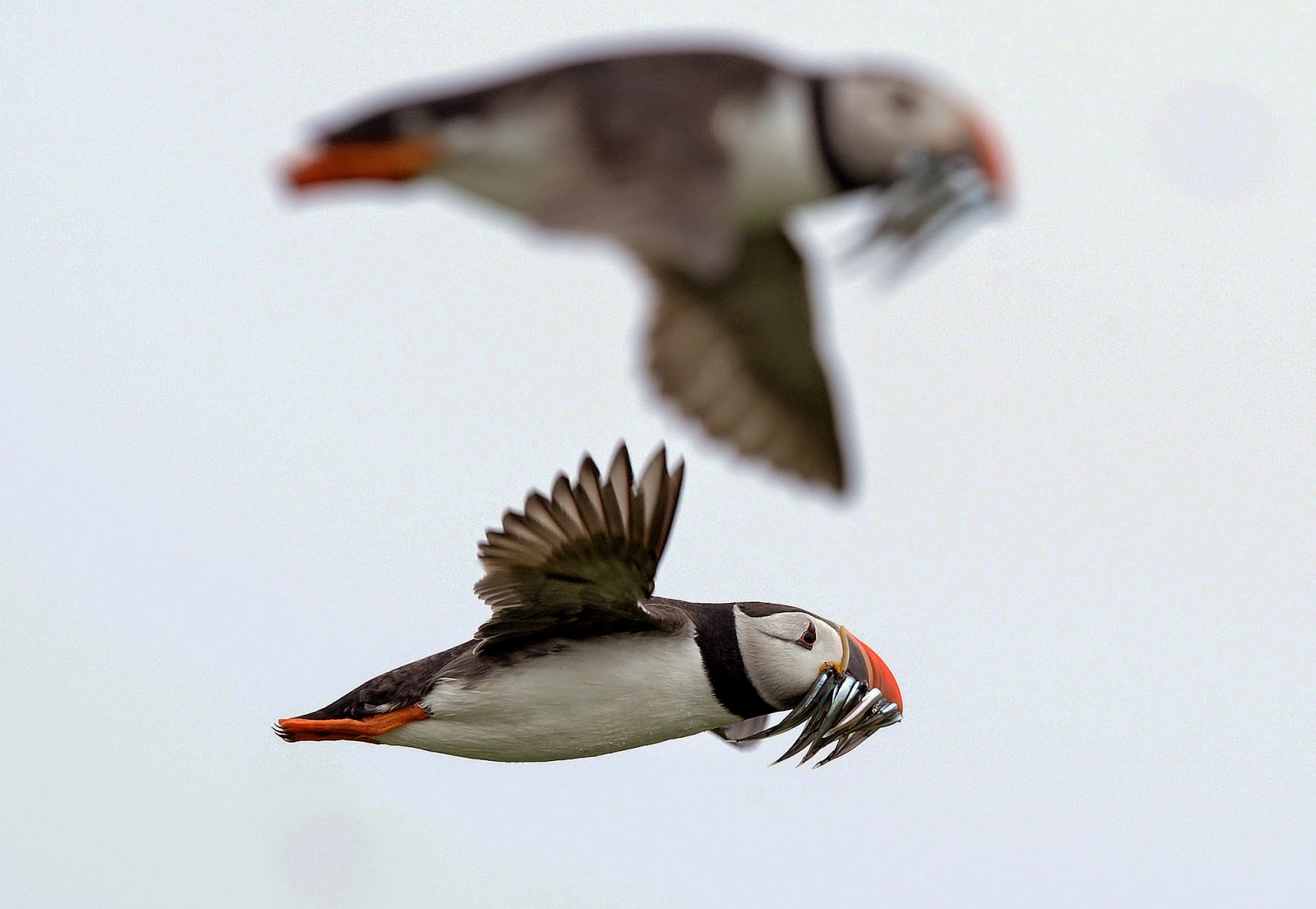
The Puffin is one of the country's favourite birds and there are few better places to see them up close than on the Farne Islands. The ever popular bird is a firm favourite with our visitors, offering endless great photo opportunities in the height of the breeding season. But how much do you know about our colourful friend?

The Puffin is unmistakable; once seen, never forgotten. With its beautiful markings, strikingly coloured bill and almost comic gait it is a bird that has endeared itself to millions. Though often known as a Sea Parrot, locally in Northumberland, the bird is known as a "Tommy Noddy". It is a member of the Auk family, alongside Gullemots and Razorbills - also present on the islands. Males and females look almost identical with the male often being slightly larger. With over half of the UK population at just a handful of sites, The National Trust's care and management of the Farne Islands is critical to their ongoing breeding success. They are an Amber listed bird species highlighting the risk their populations are potentially under. (Rare birds are nationally categorised under a Red, Amber, Green system of designation, according to their level of conservation concern). In 2014 we recorded 39,962 pairs of Puffins on the Farnes, level with the previous year. Puffins live longer than you might think, many in excess of twenty years. Some Puffins around the country have been recorded at ages of over thirty years old.


Credit and Copyright Nigel Roddis, www.nigelroddisphotography.co.uk

Each year, the Puffins return to the Farnes to breed. This is generally between April and late July with the peak breeding season being in May and June. For the remainder of the year, the birds fly out to sea, overwintering on the water, only returning to land each year for a short window to breed and raise their young. It is while out on the water, that they shed their brightly coloured bills, in favour of a dull grey winter bill colouring. But, as spring approaches, the vibrant colours return and, by the time they settle on land again, the bill is clear again for all to see. It is on, and in, the water though that Puffins, like many seabirds, gain their agility. On land they might appear awkward or clumsy, but on their home territory, the water, their evolutionary development shines. Underwater, while steering with their feet, the Puffin's wings become flippers, propelling them to depths at great speed in their quest for the next meal.


In the following clip, filmed off the Farnes in 2014, photographer Jack Perks captures a rare insight into what is happening beneath the waves around the islands. In peak season, beneath the surface of the North Sea, tens of thousands of birds are active in their search for food, particularly sandeels, a key staple of the seabirds' diet. The health of the sea around the islands and the marine environment is crucial to the well being of the bird colonies. Their success is reliant upon a healthy sea providing a rich and plentiful diet.


Copyright and Credit Jack Perks, www.jackperksphotography.com

Every five years our Ranger team will undertake a full census of the Puffins, counting their numbers to help monitor growth or decline on the colony. This information is fed into national data sets that help monitor the country's wider population.


Credit and Copyright Nigel Roddis, www.nigelroddisphotograpghy.co.uk 

The Puffin nests in rabbit-like burrows. These are clearly visible as you walk around Inner Farne or Staple Island. The peaty ground is burrowed out to create a chambered hollow below ground in which a single egg will be laid. 


Early in the season, as the Puffins return to the islands, they make a start cleaning their burrows of any accumulated materials, making a fresh abode for the months ahead. It is in here, that a single "Puffling" will hatch and grow. Incubation is normally around forty days, the chick developing over a period of a further  forty days or so. The Puffling won't leave the nest until it is ready, awaiting the moment it will see the world for the very first time as it emerges with its parents for an often clumsy waddle down to the water's edge, and its first introduction to the water, its future home. 


A Puffin preparing its nest below ground. Copyright The National Trust

The next few weeks are the ideal time to visit the islands and see the Puffins' story unfolding. Visiting information is available by clicking the Farne Islands link, at the top of the page. Just by visiting, you help support the vital work our team undertake on the Farne Islands to protect one of the country's most important seabird colonies. And don't forget, if you get any great pictures on your trip, you can share them with us on Twitter at @NTFarneIslands and @Northumb_Coast 


Special thanks to Nigel Roddis for image permissions (www.nigelroddisphotography.co.uk), and Jack Perks (www.jackperksphotography.co.uk) for the underwater clip. 


Saturday, 25 April 2015

The Breeding Season is Upon Us


The remote offshore location of the Farne Islands provide a home to over 87,000 pairs of seabirds, and passerines, with 24 nesting species. The islands are famed for their Puffins and Arctic Terns but many more species live alongside the main attractions making the Farnes one of the most significant seabird reserves in the country. Though some species live on the islands all year round, most are migratory, flying in for the summer months to breed and raise their young. Some birds return year on year, flying huge distances from the Antarctic and Africa to raise a new brood.

Each year one of the key tasks for the Rangers on the islands is to survey the thousands of breeding birds. The information gathered each year adds to a knowledge base of seabird population health, movement and well-being within the bird and scientific community.

Why do we monitor bird populations?
Watchers / wardens / rangers have monitored the bird life on the islands since the 1880's, but it was only in 1970 that systematic recording really started. Management of the site relies upon accurate information - are the measures we put in place for nesting birds having the desired effect? Is there a plentiful food supply? What part does the weather play in breeding success? What we do know is that bird numbers have increased from 27,000 pairs in 1970 to the 87,000 pairs we see today.


How do we do it?

Counting ever changing colonies of seabirds is not easy. They don't stay still for long. The cliff-nesters, such as Kittiwakes and Guillemot, require an early morning start, a relatively flat sea, and a number of Rangers in their Zodiac inflatable boat. All the cliff-nesters are counted ten times, over ten mornings, from both the boat and the land, and the figures averaged out. Some species which have a prolonged nesting season, such as Eiders, are mapped, while Terns are counted in one day - the Rangers judge the optimal time for this.


Numbered, painted stones you will see around the islands marking monitored nests

The team follow a standard methodology which is used at all seabird colonies in Britain. This means that when comparing figures, for information, between colonies, we can be confident that everyone has counted in the same way.

Our data is shared with other bodies for example, the BTO, RSPB and critically, The Joint Nature Conservancy Council. The JNCC collates all seabird records, from every colony in Britain, and presents an annual "snapshot" of the health of our seabirds. From this report it is easy to judge the real importance of the Farnes in the national, and international, picture.


How will this coming year compare to last year?

Last year the mild summer weather combined with good food availability led to an excellent breeding season on the Farne Islands. The majority of seabirds showed welcome population increases with some species bouncing back from recent poor seasons. Some of the most notable highlights included:

Shag up 37% to 795 pairs (from 582)
Kittiwake up 21% to 4,175 pairs (from 3,442)
Eider up 16% to 639 pairs (from 552)
Sandwich Tern up 16% to 959 pairs (from 824)
Arctic Tern up 15% to 2,212 pairs (from 1,921)
Guillemot up 4% to Farnes record of 51,883 individuals (increase of 1,835)

The year also gave a welcome boost for the Shag population following heavy mortality during the winter of 2012-13 which halved the Farnes breeding population the following year. There was also welcome news for Kittiwakes as the population increased by 21% and good numbers of young fledged; a positive step forward following recent poor breeding seasons.

As has been the case in recent years, it was also another good year for the islands' breeding auks with Guillemots at record levels, Puffins producing huge numbers of fledglings and the Razorbill population maintaining itself. Other birds to show increases included both the Arctic and Sandwich Terns, whilst Eiders (also known as Cuddy Ducks) made a welcome increase. Other highlights included the Farnes' first ever confirmed breeding of Shoveler whilst Northumberland's only breeding pair of Red-Breasted Mergansers nested again.

In general, it was an excellent breeding season. Strong population numbers, a plentiful food supply and the summer's settled weather contributed to high numbers of young fledging the islands. Encouragingly this success story was mirrored along other east coast seabird colonies; halting the well documented declines witnessed in recent years.


So how will this year compare?

We will have to wait and see. Birds are now nesting, Puffins are burrowing, Guillemots and Shags have started laying, and still more birds have yet to arrive. Our Ranger team are busy monitoring activity again, geared up as the main season approaches. We will post regular updates across the year on the blog and on our website www.nationaltrust.org.uk/farne-islands/visitor-information


Our website also contains all the information you need to help plan a visit in the coming months to see the birds for yourself. Our Rangers are always on hand to chat about the work they are undertaking and update on latest sightings. We highly recommend a visit in May and June to see the breeding season at its peak. At this time it is always advisable to bring a hat! For the National Trust, a charity, every visit we get to the islands directly helps support the continuation of this vital conservation work.